

Floating Discs, Roaring Lions, and Milan's Grandest Stage: Watchmaking's Week of Wonder
This week, Akhor's floating dial, Hermès's roaring lion, Ralph Lauren's steel bangle, Chronoswiss's frosted gold, Patek Philippe in Milan, and the best micro-rotor watches.

WATCH KNOWLEDGE
Akhor Opens Up the Architecture Behind Its Floating Dial

Akhor built its reputation on a single visual idea: a dial that appears to hover above the movement, with hands turning around a raised central axis. The new À Deux Mesures model pushes that concept further by splitting the display into two layers, an upper and a lower disc, each offered in a range of colors and finishes that clients can pair according to their taste. As the brand puts it, “Akhor does not create variations. Akhor composes.” Behind that freedom, however, sits a tightly controlled engineering process, as Chief Operating Officer Riccardo Monfardino explains.
Creating the illusion of levitation meant reconciling two opposing goals. “The main challenge was finding the right equilibrium between aesthetics, visual lightness, and extremely strict mechanical requirements,” Monfardino says, adding that “every micron matters.” A patented system anchors the upper disc to the movement’s axis while allowing each part to move independently, yet the real achievement lies in what stays hidden. Only 4.08 mm separate the main plate from the upper disc, a gap that shaped the 39 mm cushion case and its 11 mm thickness.
Powering the concept is the AK10 caliber, a hand-wound movement with 117 components, a variable-inertia balance, and a hacking-seconds function, delivering a 60-hour power reserve while carrying COSC certification and the Geneva Seal. Every stage of its development, Monfardino notes, focused on reducing friction and refining energy transmission so the floating effect would never come at the expense of precision.
Looking forward, Monfardino envisions sapphire, ceramic, enamel, and hard stones as future dial materials, along with complications such as a tourbillon, moon phase, or day and night display, provided they do not disturb what he calls the brand’s defining lightness. Between design work by Laurent Davoli and production at Clamax Manufacture, Akhor has turned an ambitious idea into a functioning, repeatable mechanism.
Hermès Revives the Pocket Watch with a Roaring Métiers d’Art Creation

Once dismissed as a relic best suited to period dramas, the pocket watch is experiencing an unlikely comeback, fueled in part by buzzworthy releases such as the Audemars Piguet and Swatch Royal Pop. Collectors, it seems, are once again drawn to timekeeping as ritual and spectacle rather than pure function. Hermès, however, had been cultivating this territory long before the current wave, using the pocket watch format as a canvas for craftsmanship and narrative. Its latest expression, the Slim d’Hermès Pocket Roaaaaar!, unveiled at Watches and Wonders, brings together wood marquetry, mechanical refinement, and the playful spirit that runs through Hermès Horloger.
The piece centers on Roaaaaar!, an illustration by British artist Alice Shirley depicting a roaring lion, part of the imaginative animal world she has developed for Hermès silk designs. According to creative director Philippe Delhotal, the project began with that artwork rather than with technical considerations, since its contrasts and volumes translated naturally into marquetry and its openworked cover allowed light and depth to interact. Assembling the design demanded roughly 125 hours of work and 352 pieces of wood drawn from ten species, with the lion’s mane proving the hardest element to render convincingly.
The lion joins earlier Hermès creations built around Shirley’s illustrations, including a bear, a wolf, and a dinosaur, each reflecting what Delhotal describes as a refusal to compromise on technique while remaining playful in spirit. He notes, “At Hermès we do things seriously without taking ourselves too seriously.”
Beyond its visual appeal, the piece illustrates how Hermès blends its various métiers, drawing on silk design, leatherwork, and decorative arts alongside watchmaking itself. Delhotal sees no fixed limits ahead, whether through new complications or further storytelling techniques applied to the format. As he puts it, “We never know where creation and inventiveness will take us.” For collectors, that openness may be exactly what makes the pocket watch feel relevant again.
NEW WATCHES
Ralph Lauren Turns the Stirrup Case into a Sculptural Steel Bangle
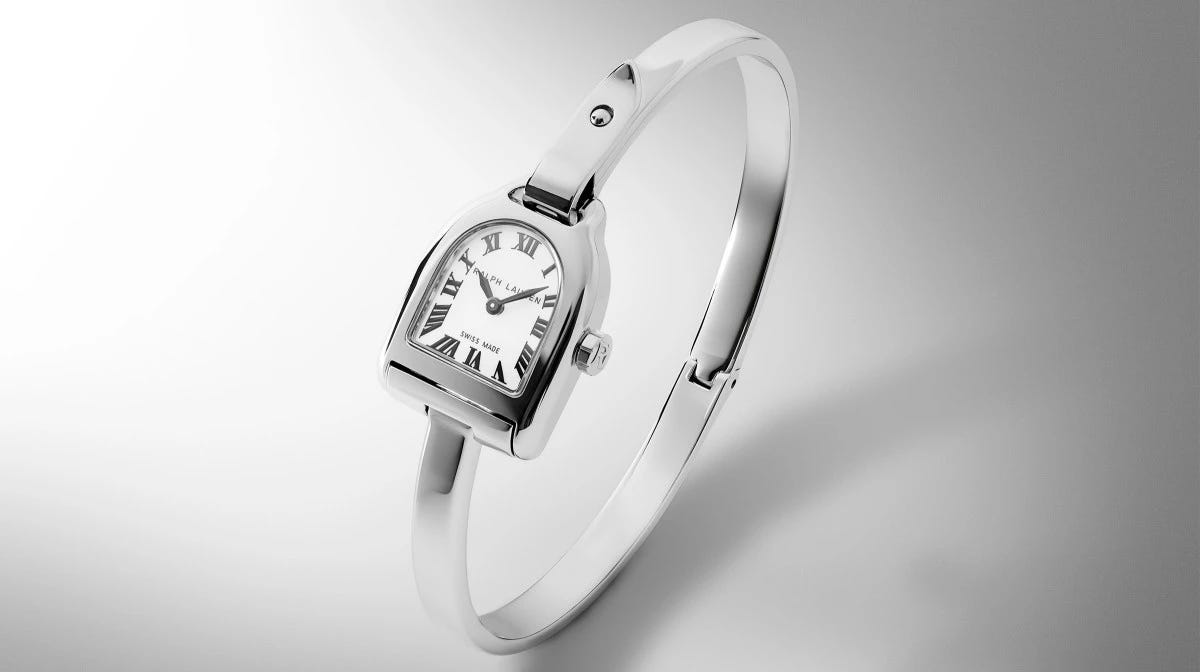
Women’s watches were once treated as an afterthought, typically a scaled-down men’s model with a decorative dial. That approach has largely disappeared, replaced by designs conceived specifically for female wrists and a growing overlap between fine watchmaking and jewelry. One clear expression of this shift is the return of the rigid bangle bracelet, and Ralph Lauren’s new Mini Stirrup Bangle fits neatly into that trend.
The Stirrup line has anchored the brand’s watchmaking identity since 2009, a year after Ralph Lauren entered the industry pairing its signature aesthetic with Swiss movements. Drawing on the arch-shaped silhouette of an equestrian stirrup, the collection has since expanded across sizes and finishes, including the Mini Stirrup introduced in 2019 for its tenth anniversary. That smallest case now receives a fresh treatment: rather than a leather strap or articulated bracelet, it sits on a polished steel bangle that wraps the wrist much like a jewelry cuff.
The equestrian references persist despite the shift to metal. The stud-and-tab closure above 12 o’clock, originally modeled on how a stirrup leather attaches to a saddle, has been reworked in steel while keeping its saddlery origins intact. Elsewhere, the design stays consistent with earlier Stirrup models: a white lacquer dial, black Roman numerals, blackened sword-shaped hands, and a domed, anti-reflective sapphire crystal. At just 16.80 mm wide and 5.60 mm thick, the case retains its jewelry-scale proportions, with water resistance to roughly 30 meters.
Given its size, a quartz movement makes practical sense, and the watch runs on the Swiss-made Ronda RL1032 caliber, consistent with the smaller models across the range. The result is a piece that reads as easily as a bracelet as it does a timepiece, suited equally to daytime wear and evening occasions.
Chronoswiss Brings Frosted Guilloché to the Pulse GMT in Gold

Chronoswiss has expanded its Pulse collection with the GMT Frosted Guilloche Gold, a new travel-time model developed at the Atelier Lucerne. Cased in 41 mm of 18-karat gold and fitted with an integrated rubber strap, the watch places a precious material within a design language built around sharp, architectural forms.
The Pulse line represents one of the more forward-looking directions in the Chronoswiss catalogue, reinterpreting familiar codes such as the onion crown and coin-edge bezel with a sturdier, more contemporary case construction. This latest release pushes the concept further through its dial treatment. A hand-guilloché brass surface is finished using a sandblasting technique in which fine synthetic corundum particles are applied with precision, producing a frosted texture that catches light differently than a conventional guilloché pattern. The hand-cut structure remains visible underneath, but its surface now reads as softer and more textured, giving the dial a quality somewhere between metalwork and stone.
That dial supports two rotating GMT discs, driven by the Chronoswiss Manufacture Caliber C.6002, built in partnership with La Joux-Perret. A 24-hour disc at 9 o’clock tracks a second time zone, while a 12-hour disc at 3 o’clock keeps home time visible, with central minutes and seconds shared between both displays. The movement runs for 55 hours on a full wind and is engineered as a functional two-timezone system rather than a purely decorative complication.
The gold case adds weight and warmth to the Pulse architecture, an effect the brand offsets by pairing it with a rubber strap currently unique to this reference, creating a deliberate contrast between formal material and sport-oriented construction. Produced in Lucerne, the watch reflects an approach to craftsmanship that treats traditional techniques as adaptable rather than fixed, aiming to keep established watchmaking methods feeling current for a contemporary audience.
BUSINESS NEWS
Patek Philippe Announces Its Seventh Grand Exhibition, Heading to Milan

Patek Philippe will bring its Grand Exhibition series to Italy for the first time this October, staging the WATCH ART Milan 2026 event from October 2 to 18 at the newly renovated Palazzo delle Scintille, rebranded CityOval, within the CityLife district. The choice reflects Italy’s long-standing status as one of the manufacture’s key markets, home to collectors known for their appreciation of craftsmanship and design.
Since the concept launched fourteen years ago, these free public exhibitions have drawn roughly 165,000 visitors across six prior editions in Dubai, Munich, London, New York, Singapore, and Tokyo. Milan will surpass them in scale, occupying nearly 2,900 square meters beneath a 30-meter dome and spreading across 15 themed areas that recreate settings from Geneva, including the manufacture’s headquarters, its Plan-les-Ouates production site, and the Patek Philippe Museum.
Around 500 timepieces and objects will be on display, spanning the current collection alongside a Rare Handcrafts selection of 27 pieces. Two unique creations stand out within that group. The “Burano” pocket watch, worked in cloisonné, flinqué, and paillonné enamel alongside hand-engraving, draws on the colors and lacemaking traditions of the Venetian island for which it is named. The “Sicilian Oranges” dome table clock, meanwhile, uses Grand Feu cloisonné enamel and miniature painting to build a two-plane scene of orange groves set against the city of Palermo, a technique requiring between nine and eleven firings per plate.
Also featured will be more than ninety pieces from the Patek Philippe Museum, including an 1897 pocket watch made for King Umberto I of Savoy, alongside landmark pieces from the manufacture’s own history such as the Calibre 89 and the Grandmaster Chime Ref. 5175. As with previous editions, the exhibition will coincide with the release of several limited-edition models across the collection.
Five Approaches That Show What the Micro-Rotor Can Still Do

Patented by Universal in 1954, the micro-rotor remains one of watchmaking’s more elegant solutions, prized for its compact footprint and the unobstructed view it leaves of the movement beneath. Achieving that efficiency within a small package is no simple matter, since a micro-rotor must generate winding power comparable to an oscillating weight roughly four times its size. Manufacturers typically build them between 2.5 mm and 3.5 mm in diameter, with a thicker outer edge to boost rotational efficiency, ideally positioned in line with the barrel and balance wheel. The design suits lighter complications such as a GMT or date function well, though it tends to lose effectiveness as more demanding mechanisms are added, a limitation Louis Moinet and later Tec Ébauches attempted to address through dual micro-rotor systems, an approach that has not seen wider adoption.
Few brands illustrate the concept’s appeal better than Laurent Ferrier, whose founder left Patek Philippe after three decades to build his own watches around the micro-rotor’s visibility and restraint, following in the tradition Patek Philippe itself set with Caliber 240 in 1977. More recently, watchmaker Dominique Renaud has pushed the architecture further with a patent-pending system pairing a platinum weight with a central spring, aiming to power heavier complications than conventional micro-rotors typically allow.
Elsewhere, Piaget and Bvlgari have used the format to chase thinness, embedding the rotor within the caliber itself across Piaget’s 12XX family and Bvlgari’s Octo Finissimo. Roger Dubuis takes the opposite approach, shaping the micro-rotor into a star-like form within heavily skeletonized movements alongside multiple balance wheels or tourbillons. Speake-Marin, meanwhile, has built its identity around the micro-rotor through its own movement manufacturer, Le Cercle des Horlogers, applying it across colorful, contemporary designs including its popular Ripples line. Traces of the same architecture also appear at Chopard, Girard-Perregaux, Richard Mille, and several other houses.


You forget Horage, that’s been making micro rotors for ages.
And they emphasize the supreme engineering challenge of doing it well. It’s not overly hard to make, but it’s overly hard to make one that winds quickly and efficiently. Some of the players you mentioned are known to have micro rotors that wind poorly and mean a watch is often in the bottom end of it’s spring force.